
Trudeau Institute Researchers Closing the Gap on a Better Model to Test Tuberculosis Treatments
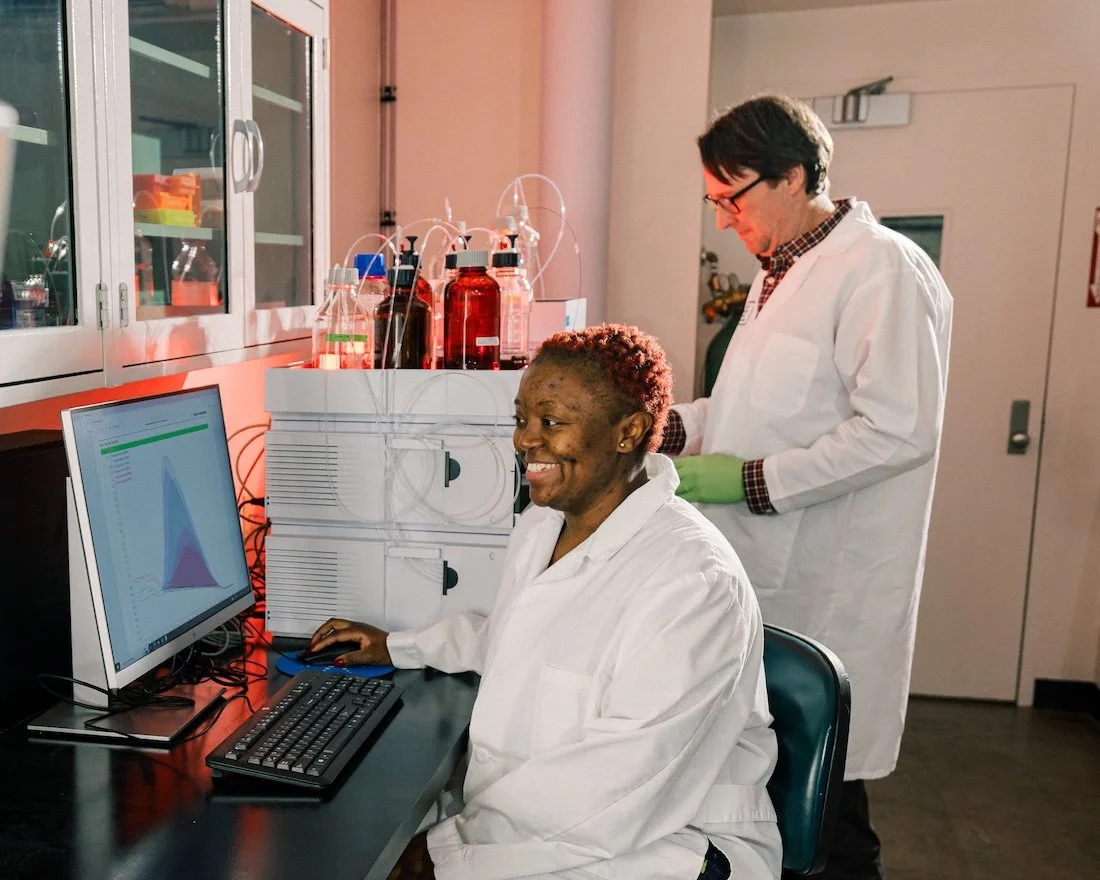
Dr. Gaëlle Guiewi Makafe and Dr. Brian Weinrick
Saranac Lake, NY — Tuberculosis is still the world’s leading infectious disease killer, and one of the biggest challenges in developing new treatments is that early testing does not always reflect what happens in the human body. Scientists at Trudeau Institute are working to close that gap.
In a study published in the February 2026 issue of Infection and Immunity, a research team led by Principal Investigator Dr. Brian Weinrick describes improved research models of tuberculosis that more consistently reproduce the complex lung lesions seen in human disease.
These models capture key features of severe TB, including damaged tissue, low oxygen environments, and varied immune responses. It is these conditions that can make the bacteria harder to eliminate and reduce the effectiveness of treatment.
“Understanding how tuberculosis bacteria persist in these diverse and hostile microenvironments is critical to designing better therapies,” said Dr. Gaëlle Guiewi, Research Associate Scientist and lead author on the study. “Our goal was to establish systems that reliably reflect the pathological complexity of human disease.”
This level of consistency has been a longstanding challenge in tuberculosis research. Variability in early-stage models can make it difficult to determine whether a therapy is truly effective or if results are being influenced by differences in the model itself.
“Variability between patients has been a longstanding challenge in TB modeling,” Dr. Guiewi said. “By reducing that variability, we can more clearly evaluate how immune responses and drug regimens perform under conditions that better reflect advanced disease.”
For researchers developing new treatments, that clarity matters. Many therapies show promise in early testing but fail later, in part because they were not evaluated in systems that capture the full complexity of the disease.
These models provide a more realistic way to study how tuberculosis behaves under the kinds of conditions clinicians are trying to treat. By better reflecting the complexity of human disease, they allow researchers to ask more targeted questions about why certain therapies succeed or fail, and to make more informed decisions before moving into clinical trials.
While the study focuses on tuberculosis, the work also contributes to a broader understanding of how the immune system functions in damaged or oxygen-limited tissue which are conditions that are relevant to other infectious diseases as well as chronic inflammation and cancer.
By improving how tuberculosis is studied before therapies reach patients, this work represents a step toward more predictive, efficient, and ultimately more effective treatment development.
Read the publication here